
News worth reporting
26.06.2026, Hong Kong
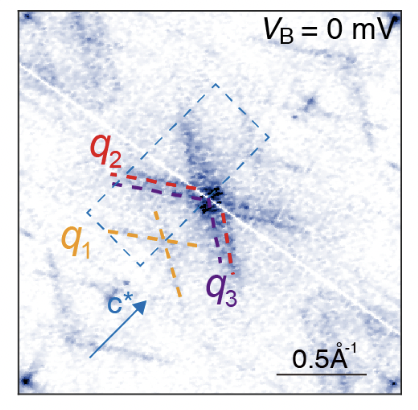
New Preprint Online: Spectroscopic Fingerprints of a Ferroaxial Charge Density Wave
🚀Excited to share our latest preprint, now available on the arXiv (link: https://arxiv.org/abs/2606.21872)!
In the hunt for new, exotic states of matter, some are incredibly good at hiding. Our team's latest research zeroes in on a highly elusive "hidden" state—a ferroaxial charge density wave (CDW)—in the material lanthanum tritelluride.Previous optical measurements indicate the presence of ferroaxial order. In our work, we have directly visualized exactly how this order is embedded within the material's electronic structure.
🔬 Because this state doesn't respond to traditional electric or magnetic probes, we had to get creative. We developed a novel approach combining two powerful microscopic techniques: mapping out electron energy and momentum, and then using strategically placed single cobalt atoms as atomic "spotlights" to clearly see the unique electronic fingerprint of ferroaxial order in scanning tunneling microscopy measurements
💡Key Takeaway: This direct observation doesn't just solve a mystery in this specific material; it provides a new roadmap for uncovering hidden and complex electronic orders across quantum materials. Ultimately, this understanding could pave the way toward next-generation data storage and ultra-fast, light-controlled electronics based on ferroaxial CDWs.
We are grateful for the collective efforts of all collaborators at The Hong Kong University of Science and Technology, Princeton University, and City University of Hong Kong involved in this work.
23.04.2026, Hong Kong
New Preprint Online: Distinguishing and Separating In-Plane Hall Responses
Excited to share our latest research, now available as a preprint on arXiv (link: https://arxiv.org/abs/2604.20227)!
In the fascinating study of magnetic quantum materials, a major challenge has been to distinguish between several different electrical signals that coexist and get mixed up in our measurements. It's like trying to isolate a single voice in a chorus where everyone is singing a different tune. This ambiguity has been a roadblock for understanding the fundamental properties of these materials.
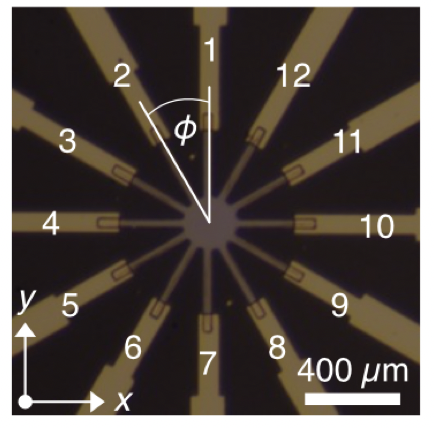
🔬 Our Discovery: Our new work introduces a universal framework to solve this problem for studies of electric Hall effects in planar measurement geometries. By combining the pictured "circular Hall bar" devices with symmetry-guided analysis methods, we introduce a novel method to tune, cleanly separate and measure each of these signals—the planar Hall effect, the symmetric transverse resistance, and the much sought-after anomalous in-plane Hall effect.
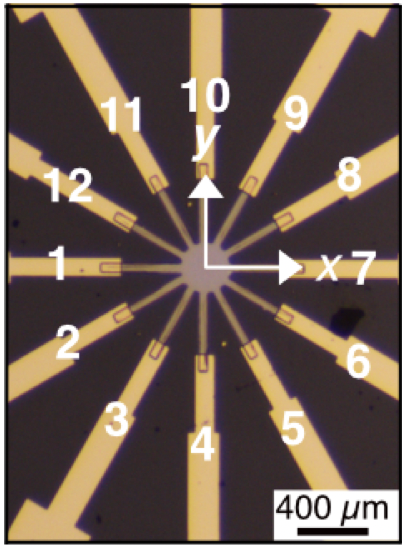
🎯 Our Impact: This advance transforms measurements of in-plane Hall responses into a powerful quantitative tool, giving us a clearer window into the intrinsic quantum geometry of materials and paving the way for new spintronic and magnetic field sensing technologies.
A huge thanks to my brilliant co-authors Soumya Sankar, Xingkai Cheng, and Junwei Liu, and our teams at The Hong Kong University of Science and Technology.
We hope this work will become a standard for future transport studies of magnetic quantum materials in the field. Check out the preprint to learn more!
16.04.2026, Hong Kong
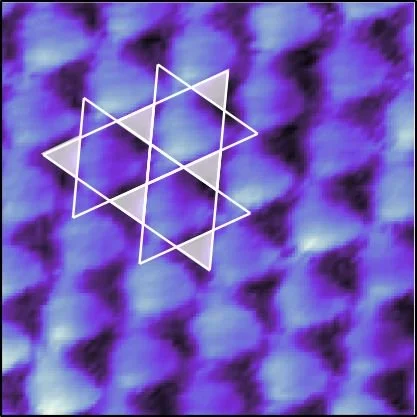
New Preprint Online: Discovery of an odd-parity f-wave charge order in a kagome metal
I am excited to share our new research, now available as a preprint on the arXiv! We've managed to capture the first-ever images of a bizarre, long-theorized pattern that electrons can form inside a quantum material.
📔 The Background:
Think of how electrons organize in a material like stacking bricks. For decades, we've understood the "conventional" patterns, which are like a simple, repeating stack (we call this 'even-parity'). But physicists have long predicted that a more exotic, "odd-parity" pattern could exist—not a simple stack, but a complex, hidden arrangement within each brick.
🔬 Our Discovery:
In our new work, using ultra-high-resolution scanning tunnelling microscopy on the quantum material CsV3Sb5, we have provided the first direct, real-space images of one of these elusive odd-parity patterns.
🤯 Why This is Exciting:
This isn't just about finding a new pattern. Our discovery reveals a cascade of fascinating physics:
A New Form of Matter-We have experimentally confirmed a new class of quantum matter that was previously only a theoretical concept.
A Deeper Mystery-The story gets even stranger! This new pattern is not the final ground state. It only appears in a narrow temperature window (between 10K and 18K) before the system transitions again into a different, completely new "hidden" phase that we cannot see directly. We've solved one puzzle only to uncover a deeper one.
Connecting to Fundamental Physics-The mechanism that stabilizes our new pattern is a rare, textbook example of "dynamical mass generation"—a concept straight out of high-energy physics, now seen in a tangible material.
This work opens a whole new direction for exploring the complex hierarchy of competing states in quantum materials. A big thank you to my student Andrew, leading this work, my brilliant co-authors at the ITP in Beijing, Karlsruhe Institute of Technology (KIT), University of Minnesota, UC Santa Barbara, City University of Hong Kong, The Hong Kong University of Science and Technology and all collaborators!
You can read the full story here:
https://arxiv.org/abs/2604.14538
14.01.2026, Hong Kong
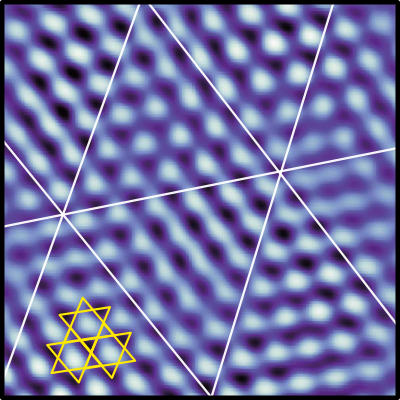
Paper published in Physics. Rev. X: Nematic Order and Orbital Selective Mott State in a Partially Filled Kagome Flat Band
Check out our new publication on the observation of electron nematic order and an orbital selective Mott state in a partially filled kagome flat band (Link: https://journals.aps.org/prx/abstract/10.1103/c93j-k53f)! This result is so close to my heart, because I proposed exactly this discovery in my faculty application materials back in fall 2019! More than six years, a move across the globe, two children, one epidemic, one lab setup, and many measurements later, we delivered! Special thanks go to my postdoc Sophie Chen, my graduate student Andrew Zheng, my collaborators Adrian Po and Xi Dai at HKUST and everybody else involved.
Background: Strong Coulomb interactions between electric charge carriers at microscopic length scales can induce novel quantum states and change the material properties, potentially leading to new device functionalities. This effect is believed to be particular strong in so-called flat band materials, where electric charge carriers are almost standing still, and the mutual Coulomb repulsion between them dominates the system properties.
Our discovery: Combining molecular beam epitaxy with scanning tunnelling microscopy measurements, we show that a variety of strongly correlated electronic states arise in the partially filled kagome flat band of CoSn at different temperatures and flat band fillings that can be controlled by chemical doping with Fe. We detect electron nematic order over a wide doping range at high temperatures. At ideal Fe doping, we also detect an orbital selective Mott state that depends into a correlated metal state upon doping with electrons and holes. Our observations demonstrate that the electronic ground state of kagome flat bands sensitively depends on the complex interplay between geometric frustration, strong Coulomb repulsion, orbital degeneracy, and filling fraction at different temperatures.
Why does it matter? Strong electron interactions in electronic flat bands are a central research topic and believed to be a key ingredient to realise high-temperature superconductivity and other technologically relevant quantum states. Flat bands in kagome lattice materials have inspired research for more than a decade, because comparably strong Coulomb interactions could favour the emergence of strongly correlated states at elevated temperatures. However, until now, strongly correlated states appearing in kagome flat bands have not been discovered until now. We close this gap by directly demonstrating a variety of strongly correlated states appearing at different temperatures and flat band occupations.
What comes next? Disorder is often the biggest enemy of long-range ordered quantum states. To substantially reduce the disorder in our samples induced by Fe-doping, we are already working on realising modulation doping of CoSn with FeSn using molecular beam epitaxy. We anticipate that this technical achievement will unlock further exciting quantum states at hopefully even higher temperatures--stay tuned!
12.12.2025, Hong Kong
Paper published in Nature Communications: Room temperature observation of the anomalous in-plane Hall effect in a Weyl ferromagnet
Check out our new paper on the prediction and observation of the anomalous in-plane Hall effect (IPHE) at room temperature! This effect has been challenging to observe in the past because of strict symmetry requirements. Here, we combine molecular beam epitaxy of the kagome metal Fe3Sn, electric Hall effect measurements, and theoretical calculations to propose and demonstrate that the kagome lattice motif combined with spin-orbit coupling and canted ferromagnetism induces the anomalous in-plane Hall effect at room temperature via topological Weyl points. We can also tune the amplitude of this effect by fabricating magnetic heterostructure devices.
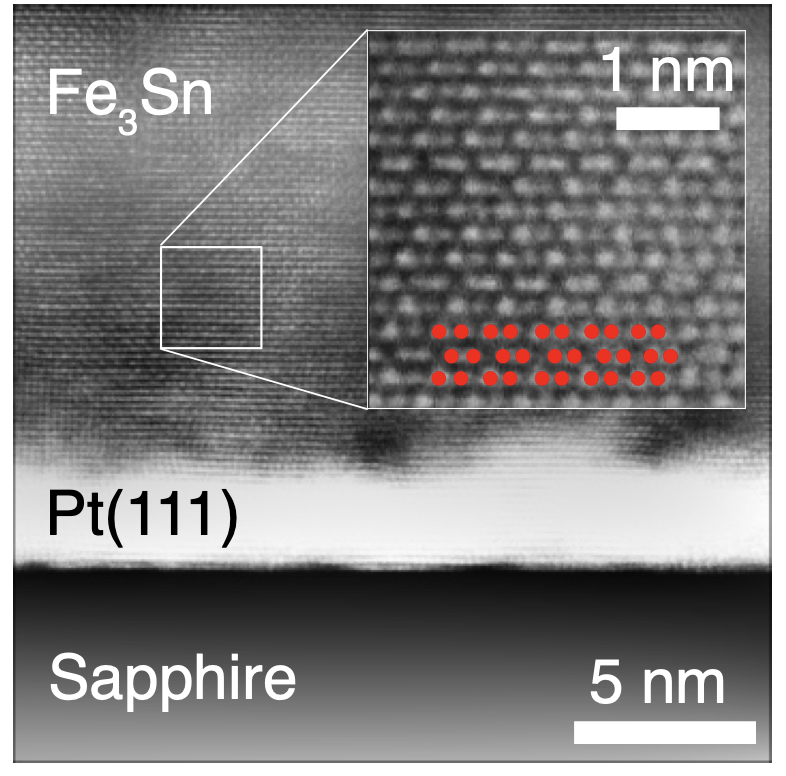
How did we achieve this? Guided by theoretical symmetry analysis, we combined the kagome lattice motif with spin-orbit coupling and canted ferromagnetism to break the relevant symmetries for facilitating the anomalous in-plane Hall response. Conducting Hall measurements on circular Hall bar devices, which were fabricated from epitaxially grown thin films of Fe3Sn, enabled us to separate different contributions to the Hall response, identifying the IPHE through its unique characteristics.
Why does this matter? Our work showcases that exotic topological transport responses induced by the quantum geometry of the electronic wave function can exist at room temperature, offering opportunity to build functional devices.
What comes next? We are already designing and fabricating novel device structures to realize sensitive magnetic field sensors based on this anomalous in-plane Hall effect. There has been so much talk about quantum materials for 10 years. It is amazing to see that this field is now approaching a point where talk becomes reality--stay tuned!
This work is the outcome of another fun collaboration with my fantastic colleagues Junwei Liu and QIMING SHAO at The Hong Kong University of Science and Technology. Kudos to my hard-working students and to everyone involved!
Link: https://www.nature.com/articles/s41467-025-67111-x
14.11.2025, Hong Kong
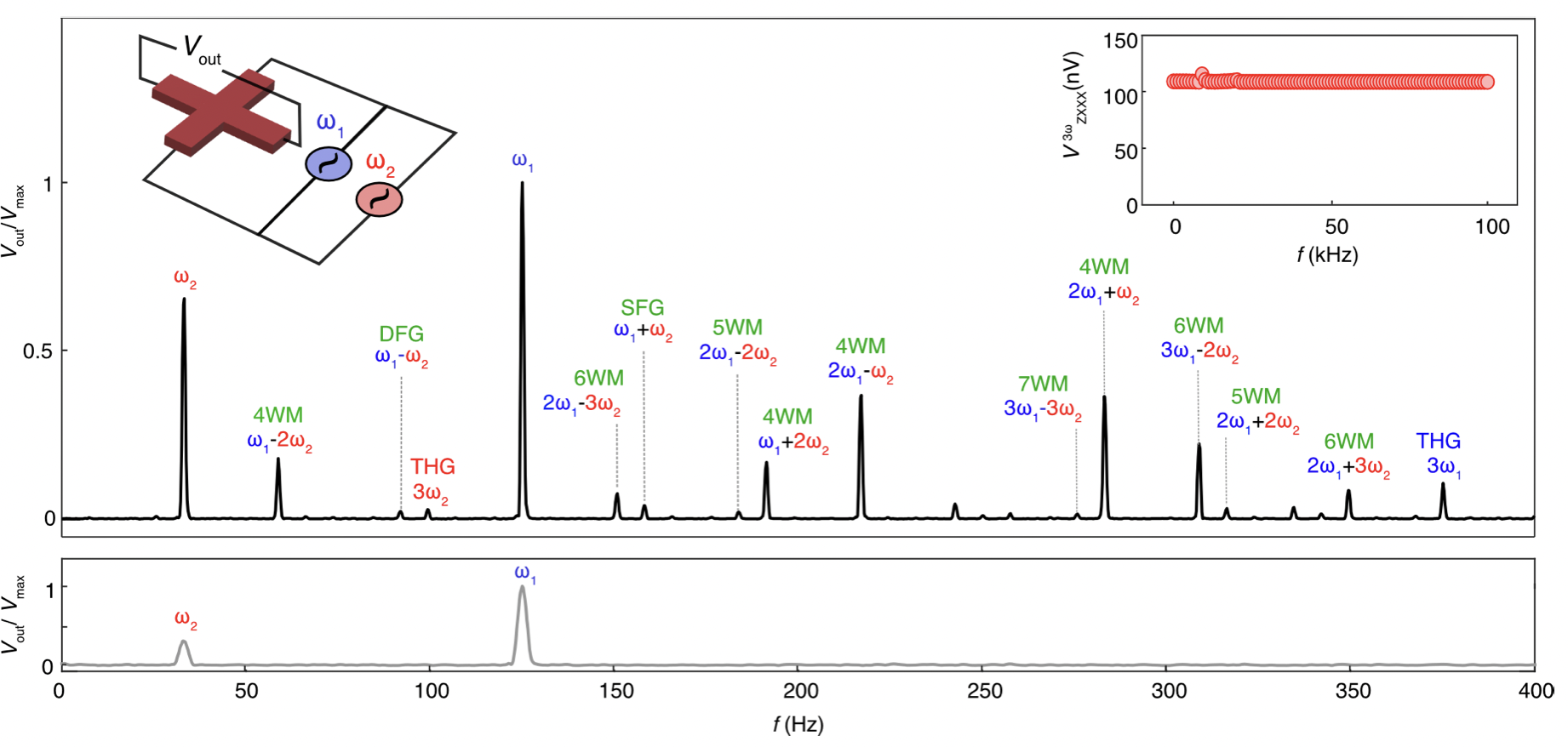
New preprint online: Broadband nonlinear Hall response and multiple wave mixing in a room temperature altermagnet
Check out our new manuscript on the nonlinear electric material properties of altermagnets! Preprint: arXiv:2511.10471 [cond-mat.mes-hall] (2025)
We discover a nonlinear Hall response in the altermagnet CrSb at room temperature, which is induced by a Berry curvature quadrupole. We then utilize the nonlinear susceptibility of this quadrupole to realize a multiple wave mixing device, generating broad band frequency output. We do this on our desk, no cryostat, no magnet needed, a true quantum material 😎
Why does it matter? Two things:
At a scientific level, our results demonstrate that the electric susceptibility of altermagnets is precisely determined by the magnetic crystal order encoded in the altermagnetic order parameter.
At a technological level, altermagnets were so far mostly discussed in the context of spintronics. Through realizing multiple wave mixing at room temperature, our results significantly expand the scope of applications of altermagnets to including THz generation, high-frequency elevtronics, and energy harvesting.
Fantastic collaboration with many people The Hong Kong University of Science and Technology, City University of Hong Kong Gifu University @mpicpfs
17.10.2025, Hong Kong
New preprint online:
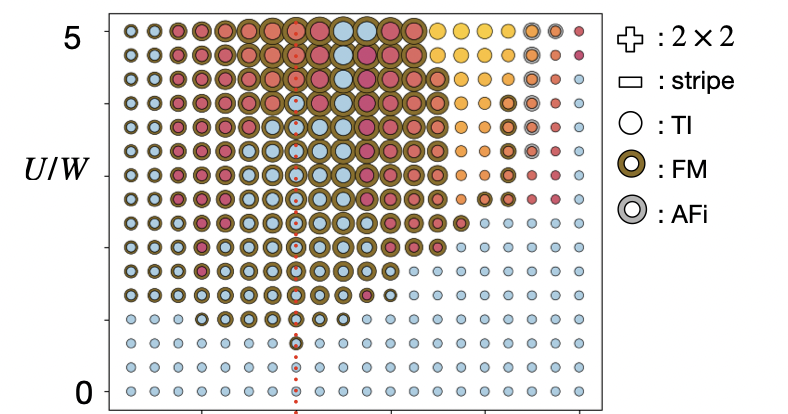
Our recent experiment on Fe-doped CoSn has uncovered a series of correlated phases upon hole doping of the kagome flat bands (see preprint at link). Among the phases observed, a nematic phase with a six- to two-fold rotation symmetry breaking is found to prevail over a wide doping and temperature range. Motivated by these observations, our close collaborators in Adrian Po’s group investigated the interaction-driven phases realized in a kagome model with partially filled, weakly dispersing flat bands. Density-density interactions up to second-nearest neighbors are considered.
We identify a close competition between ferromagnetic and nematic phases in our self-consistent Hartree-Fock calculations: while on-site interaction favors ferromagnetism, the sizable inter-sublattice interactions stabilize nematicity over a wide doping window. Competition from translational-symmetry-breaking phases is also considered. Overall, our results show that nematicity is a generic outcome of partially filled kagome flat bands and establish a minimal framework for understanding correlated flat-band phases.
Link: arXiv:2510.14593 [cond-mat.str-el] (2025)
01.09.2025, Hong Kong
Welcome to our new graduate students Thomas, Phoenix, and Weilin
We are excited to welcome new team members: Thomas is a long-time lab member who worked on twisted TMD fabrication during his undergrad. He now joins our group to perform scanning tunneling microscopy (STM) measurements on twisted bilayer transition metal dichalcogenide samples. Weilin joins us from the University of the Chinese Academy of Sciences to design and build a charge qubit microscope. Having designed and built an STM experiment from scratch during his undergraduate studies, he has a lot of experience under his belt to tackle this challenging project. Phoenix is also an HKUST alumnus who joins our group as a Master student to grow ultra-thin epitaxial thin films of Bi.
01.07.2025, Hong Kong
Welcome Qirong!
We are excited to welcome Qirong Yao to our group. Qirong joins the JackLab as a postdoctoral research associate to work on visualizing interacting many-body states in magic angle twisted bilayer graphene. He joins us from the UC Santa Cruz and brings in a whole lot of expertise in STM on graphene devices. Welcome!
25.01.2025, Hong Kong
Room temperature observation of the anomalous in-plane Hall effect in epitaxial thin films of a Weyl ferromagnet
We are pleased to draw your attention to our recent results that were achieved in collaboration with Prof. Junwei Liu’s group at HKUST. Combining molecular beam epitaxy of the kagome metal Fe3Sn with measurements of the electric Hall effect and theoretical calculations, we propose and experimentally demonstrate that the interplay of the kagome lattice motif with spin-orbit coupling and canted ferromagnetism with large exchange interactions gives rise to the anomalous in-plane Hall effect (IPHE) at room temperature that is induced by topological Weyl points in the electronic band structure. Synthesizing a topological heterostructure including layers of Fe3Sn and ferromagnetic CoFeB, we further show the enhancement of the anomalous IPHE through the magnetic stray field of the CoFeB layer. Our work establishes a design paradigm for topological magnets and heterostructures to discover and control novel anomalous Hall effects toward their use in technological applications.
Preprint: arXiv:2501.13602 [cond-mat.mes-hall] (2025)
01.10.2024, Hong Kong
Farewell To Yekta, Jason, and Justin
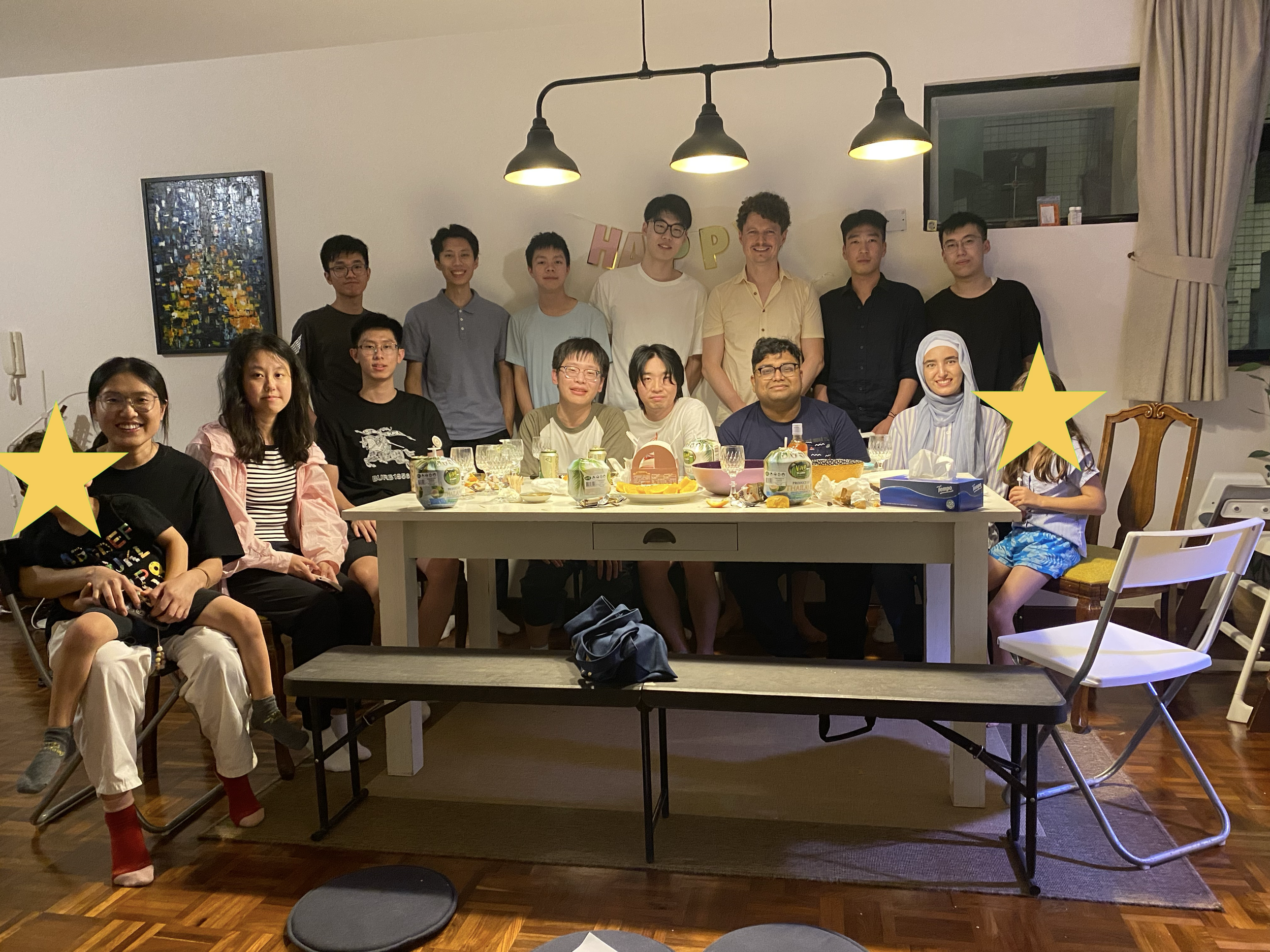
After a summer brimming with undergraduate research in our lab, we say goodbye to our last summer student of 2024. Thank you Yekta, Jason, and Demin for all your hard work and contributions to our group and research and best of luck for your future paths. It is always a pleasure to have undergraduates join us from around the world for a few months of research and (from what I hear as feedback) fun. Are you interested to join us for a summer research internship? Get in touch!

11.09.2024, Hong Kong
New Pre-Print Online: Phase Diagram of Strongly Correlated States in a Partially Filled Kagome Flat Band
Check our new paper on the arXiv (link). We present experimental evidence obtained from scanning tunnelling microscopy measurements for a cascade of strongly correlated states, such as a nematic order parameter and an orbital selective Mott state, appearing in the partially occupied kagome flat bands of Co1−xFexSn whose filling can be controlled by the Fe-doping level x. Our observations demonstrate that the electronic ground state of a kagome flat band depends on the complex interplay between strong Coulomb repulsion, 3d-orbital degeneracy, and flat band filling fraction at different temperatures. More broadly, our research establishes kagome materials as a unique platform to search for strongly correlated quantum states that arise in non-trivial flat bands and can be controlled by the filling fraction.
01.090.2024, Hong Kong
We welcome our new graduate students Yuqi and Junwei
With the start of the new fall semester, we are delighted to welcome two graduate students to our group. Yuqi joins us from the Huazhong University of Science and Technology in Wuhan. She has already spent a summer internship and final year project with us and will work on the fabrication and examination of topological magnetic materials.
Junwei joins us from the University of Science and Technology in Hefei. He will contribute his expertise in the construction of cryogenic scanning probe microscopy to develop new scanning probe modalities for the study of topological many body states in two-dimensional materials at millikelvin temperatures.
01.08.2024, Hong Kong
Farewell to Sophie and Faith
This summer, we bid our farewell to Sophie and Faith who took a leading role in getting our lab up and running. As a postdoctoral fellow, Sophie's contribution to the construction of our MBE-STM, the training of students, and numerous scientific projects cannot be overestimated. You will be missed, and we wish you all the best in the next step of your career at the Max-Planck-Institute for Solid State Research.
Faith joined our group in his first year of study as part of the Fab Four team of undergraduates that fearlessly set up the MBE systems, which keeps delivering samples until today. He was also a great soccer player, and we wish him all the best for his foray into quantum information technology in Shanghai!

20.06.2024, Hong Kong
RGC Funding Awarded
We are grateful for the continuous support by the Hong Kong Research Grants Council which funded our project on ‘Microscopic insights into the integer and fractional quantum anomalous Hall states of twisted bilayer MoTe2’
17.06.2024, Hong Kong

Our Work on Berry Curvature Multipoles Published in PRX
We are delighted that our manuscript ‘Experimental Evidence for a Berry Curvature Quadrupole in an Antiferromagnet’ has been published in Physical Review X (link). Berry curvature multipoles appearing in topological quantum materials have recently attracted much attention. Their presence can manifest in novel phenomena, such as nonlinear anomalous Hall effects (NLAHE). The notion of Berry curvature multipoles extends our understanding of Berry curvature effects on the material properties. Hence, research on this subject is of fundamental importance and may also enable future applications in energy harvesting and high-frequency technology. We demonstrated a fundamentally new mechanism for Berry curvature multipoles in antiferromagnets that are supported by the underlying magnetic symmetries. Carrying out electric transport measurements on epitaxial thin films of the kagome antiferromagnet FeSn, we observe a third-order NLAHE, which appears as a transverse voltage response at the third harmonic frequency when a longitudinal ac drive is applied. Interestingly, this NLAHE is strongest at and above room temperature. At a practical level, our study establishes NLAHE as a sensitive probe of antiferromagnetic phase transitions in other materials—such as moiré superlattices, two-dimensional van der Waal magnets, and quantum spin liquid candidates, which remain poorly understood to date. More broadly, Berry curvature multipole effects are predicted to exist for 90 magnetic point groups. Hence, our work opens a new research area to study a variety of topological magnetic materials through nonlinear measurement protocols.
12.03.2024, Minneapolis
APS March Meeting 2024
We just returned from our APS March Meeting trip to Minneapolis, where we presented our work on the in-plane Hall effect in a Weyl ferromagnet (Soumya), microscopic evidence for a chiral flux phase (Andrew), and interacting many-body phases in a kagome flat band (Berthold). It was a fun and very productive meeting to discuss our ongoing work with our collaborators, develop new research ideas, and to see old friends and make new friends. Check out the ‘Photos’ section for some impressions from our trip. We look forward to next year’s meeting in Los Angeles!

20.12.2024, Hong Kong
Funding Awarded by HKUST Research Equipment Competition
Our application to the HKUST equipment grant competition was successful and we were awarded funding to procure an atomic force microscope. This instrument will play a central in our efforts to fabricate atomically clean samples made from exfoliated two-dimensional materials, such as magic angle twisted bilayer graphene and twisted homobilayers of transition metal dichalcogenides.
20.12.2023, Hong Kong
Our work on visualising the localised electrons of a Kagome Flat Band published in PRR

We are excited to share the first piece of work (link) that comes out of our home-built MBE-STM system. In this work, we used spectroscopic mapping with the scanning tunnelling microscope (STM) to examine the real space localisation of the non-trivial electronic wave functions of a kagome Flat Band. Kagome metals host an electronic flat band in their electronic structure. Because the kinetic energy of electrons occupying these flat bands is quenched, quantum-mechanical interactions can emerge as the leading energy scale. Hence, the kagome materials are an attractive venue to explore the possible emergence of strongy-correlated many-body states that are predicted to exist in their flat bands. However, the extent to which the complex structure of realistic materials counteract the localizing effect of destructive interference is hitherto unknown and a detailed understanding of the real-space distribution of the electronic states of kagome flat bands has not been developed yet. We used scanning tunneling microscopy to visualize the electronic states of a kagome flat band at the surface of CoSn, a kagome metal. Consistent with results from model calculations, we find that the local density of states associated with the kagome flat bands exhibits a unique real-space distribution by which it can be distinguished from the local density of states of dispersive electron bands and trivially localized states, such as well-localized orbitals and surface resonances. Our findings provide fundamental insight into the electronic properties of kagome metals and present a key step for future research on emergent many-body states in these systems.